
How music therapy may support communication, relationships and social engagement for adults with mental health diagnoses
For many adults living with mental health diagnoses, recovery is about more than managing symptoms. It can also involve building confidence, strengthening relationships, increasing participation in community life, developing communication skills, and finding meaningful ways to connect with others. Within this broader recovery framework, music therapy may be used as one component of multidisciplinary support.
Adults accessing mental health services may experience challenges such as social withdrawal, reduced confidence in group settings, difficulty initiating conversations, loneliness, changes in motivation, or difficulties expressing and processing emotions. These experiences can affect participation in work, education, relationships, recreation and community activities. Music therapy may provide opportunities to work towards these challenges through structured, goal-directed musical experiences.
Registered Music Therapists are allied health professionals who use evidence-informed musical experiences within a therapeutic relationship to support individual goals. The music itself is not the treatment. Rather, music provides a medium through which therapeutic work can occur.
Why Are Social Skills Important?
Social connection is a significant contributor to mental health and wellbeing. Many adults receiving mental health support identify goals related to:
- Building confidence in social situations
- Initiating and maintaining conversations
- Developing friendships and relationships
- Participating in community activities
- Improving communication skills
- Increasing independence and self-advocacy
- Strengthening emotional awareness and expression
- Managing stress and difficult emotions in social contexts
Not every person receiving mental health support will have these goals. Music therapy interventions are always tailored to the individual’s circumstances, strengths and priorities. However, social participation and communication are common areas of focus because they can influence many aspects of daily life.
What Might This Look Like in Music Therapy?
Music therapy sessions may include:
- Instrumental improvisation
- Playing familiar songs
- Songwriting
- Music listening and discussion
- Group music-making
- Learning new musical material
- Rhythm-based activities
- Collaborative music creation
While these activities may appear musical on the surface, the therapeutic purpose often extends far beyond music.
For example:
| Musical Activity | Therapeutic Process | Possible Goal |
| Improvisation | Listening and responding to another person in real time | Social reciprocity and communication |
| Songwriting | Exploring experiences, emotions and personal meaning | Emotional expression and self-awareness |
| Playing music together | Practising cooperation and shared attention | Social participation and relationship building |
| Learning new music | Managing uncertainty and adapting to change | Confidence and cognitive flexibility |
| Music discussion | Reflecting on thoughts, memories and feelings | Communication and emotional processing |
The music is not the outcome. It is the medium through which therapeutic goals may be explored and practised.
What’s Happening Therapeutically?
Music naturally involves interaction.
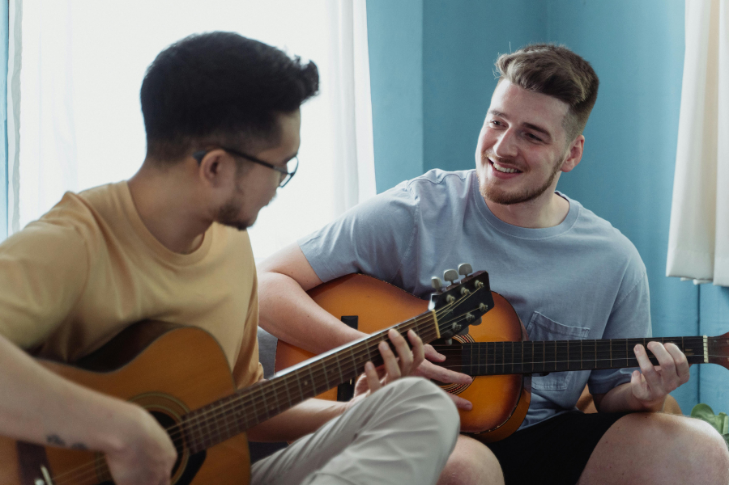
When two people improvise together, play songs together, or engage in rhythm-based activities, they are constantly exchanging information. They listen, respond, take turns, adapt and share attention.
A Registered Music Therapist may intentionally use these experiences to create opportunities for developing social and interpersonal skills.
Social Reciprocity
Many musical activities involve a natural back-and-forth exchange. One participant introduces a musical idea and another responds.
These interactions can provide opportunities to practise skills involved in everyday social communication, such as listening, responding, leading, following and taking turns.
Communication
Communication extends beyond words.
Within music therapy, communication may occur through musical choices, rhythm, tempo, volume, eye contact, gesture and body language. These experiences can create additional avenues for expression when verbal communication feels difficult or limited.
Emotional Expression and Reflection
Music can provide a structured framework for exploring emotions and personal experiences.
Through songwriting, improvisation, lyric discussion or music listening, participants may have opportunities to reflect on feelings, relationships, challenges, strengths and coping strategies.
Confidence and Self-Direction
Many music therapy interventions encourage participants to make choices, contribute ideas, lead activities and take ownership of the therapeutic process.
These experiences may support broader goals related to confidence, independence and self-advocacy.
Why Music?
Music offers several qualities that can make it useful within mental health settings.
First, music is inherently social. People often make music together, respond to one another, and collaborate toward a shared experience.
Second, music is structured. Rhythm, repetition and familiar musical patterns can provide predictability and support engagement.
Third, music can provide a focus outside of direct conversation. Rather than relying solely on discussion, the therapist and participant share an activity that can support connection, reflection and interaction.
Importantly, musical ability is not required. Music therapy is not music lessons. The therapist’s focus is on the individual’s goals, not on developing performance skills unless those skills are themselves relevant to agreed therapeutic outcomes.
An Illustrative Practice Example
The following example is illustrative and does not describe an individual QPAH client.
Imagine an adult with a mental health diagnosis who enjoys music but finds social situations challenging. They may be hesitant to initiate conversations, prefer familiar routines, and feel uncertain in new situations.
A Registered Music Therapist might initially use familiar and preferred music to establish rapport and create a predictable therapeutic environment.
Over time, the therapist may introduce collaborative music-making experiences that encourage:
- Shared attention
- Turn-taking
- Choice-making
- Creative decision-making
- Verbal discussion
- Non-verbal communication
- Exploration of new ideas within a supported context
In this scenario, the aim is not musical improvement. The music provides opportunities to practise communication, social engagement, emotional expression and interpersonal interaction in a meaningful and motivating way.
What Does the Evidence Tell Us?
Music therapy has been investigated across a range of adult mental health settings and populations. Research suggests that music therapy may support areas such as social functioning, emotional expression, interpersonal engagement and quality of life when used alongside other appropriate mental health supports.
Systematic reviews have reported potential benefits in areas related to social participation, interpersonal relationships, social interest and engagement. However, researchers also note that findings vary between studies and populations, and further high-quality research continues to be needed.
Researchers have proposed that music therapy may be particularly relevant to social and relational goals because musical interaction creates opportunities for communication, shared experiences and connection that do not rely solely on spoken language.
As with any allied health intervention, outcomes differ between individuals. Music therapy is not a replacement for psychology, psychiatry, occupational therapy, social work, medical treatment or other appropriate supports. It is most often used as part of a broader, multidisciplinary approach to mental health care.
What This Means in Practice
For adults with mental health diagnoses, music therapy may provide opportunities to work towards goals related to:
- Communication
- Social skills
- Relationship building
- Community participation
- Emotional expression
- Confidence and self-direction
- Coping and wellbeing strategies
- Meaningful engagement in shared activities
The interventions used will depend on the individual’s goals, strengths, preferences and support needs. There is no single music therapy approach that suits everyone.
Learn More About Music Therapy at QPAH
Queensland Premium Allied Health provides music therapy services delivered by Registered Music Therapists as part of person-centred allied health support.
If you would like to learn more about music therapy or discuss whether it may be appropriate in relation to a person’s goals and circumstances, QPAH’s team can provide information about available services and referral pathways.
Evidence & Further Reading
This article provides general information about music therapy practice and is not individual clinical advice. Examples are illustrative and do not describe an individual QPAH client unless explicitly stated otherwise. Music therapy is individualised, and approaches and outcomes vary according to each person’s needs, goals and circumstances.